

Understanding 3-Way Switch Wiring
Three-way switches offer control of a light fixture from two different locations, enhancing convenience and safety within a home’s electrical system.
Understanding 3-way switch wiring involves recognizing the unique functionality compared to standard single-pole switches, as detailed in various diagrams.
These diagrams illustrate how 3-way switches utilize “traveler” wires to alternate the circuit path, enabling control from either switch position.
A 3-way switch wiring diagram PDF provides a visual guide for installation, showcasing different configurations based on power source location.
Residential wiring diagrams with two lights are often used to demonstrate the basic principles of 3-way switch operation and connections.
User manuals and online videos offer step-by-step instructions, alongside diagrams, to aid in successful 3-way switch wiring projects.
What is a 3-Way Switch?
A 3-way switch isn’t simply an on/off device; it’s a specialized electrical component designed to control a single light fixture from two distinct locations. Unlike a standard switch, a 3-way switch doesn’t have definitive “on” and “off” positions, but rather alternates the circuit path.
These switches feature three terminals: a common terminal, and two traveler terminals. The common terminal connects to either one of the traveler terminals, completing the circuit and powering the light. A 3-way switch wiring diagram PDF clearly illustrates these connections.
The key to understanding a 3-way switch lies in its ability to redirect electrical flow through either of the traveler wires, depending on the position of both switches. This allows for flexible control, such as turning a hallway light on from either end of the hall.
Residential wiring diagrams often depict 3-way switches in various configurations, highlighting how the traveler wires connect between the two switches to achieve this functionality; User manuals emphasize that proper identification of these terminals is crucial for correct installation.
The Basic Principle of Operation
The core principle behind 3-way switch operation revolves around redirecting the flow of electricity through “traveler” wires. A 3-way switch wiring diagram PDF visually demonstrates this redirection process, showing how each switch alters the circuit path.
When one switch is toggled, it connects the common terminal to one traveler wire, completing the circuit. Simultaneously, the other switch can be in either position. However, for the light to turn on, the second switch must connect its common terminal to the same traveler wire.
Changing the position of either switch breaks and remakes the circuit through a different traveler wire, effectively controlling the light. This alternating action is what allows control from two locations.
Understanding this principle is vital when interpreting a residential wiring diagram. User manuals often explain this concept with simplified illustrations, emphasizing that the switches don’t directly turn the light on or off, but rather direct the electrical current.

Essential Components for Wiring
3-way switches, appropriate gauge electrical wire, and connectors are crucial; a 3-way switch wiring diagram PDF details these needs.
Essential tools include wire strippers, screwdrivers, and a multimeter for safe and effective installation, as shown in guides.
3-Way Switches: Traveler, Common, and Line Terminals
3-way switches differ from standard switches, possessing three terminals instead of two: the common, line, and traveler terminals.
A 3-way switch wiring diagram PDF clearly identifies these terminals, crucial for correct installation and circuit functionality.
The common terminal receives power from either the power source or the other switch, directing electricity to the light fixture.
Traveler terminals are paired and carry the current between the two 3-way switches, enabling alternating control.

The line terminal connects directly to the power source, providing the initial electrical feed into the circuit.
Understanding the function of each terminal, as illustrated in diagrams, is vital for avoiding incorrect wiring and potential hazards.
Proper identification, often color-coded, ensures the switches operate correctly, allowing control of the light from both locations.
Incorrectly connecting these terminals will prevent the circuit from functioning as intended, necessitating careful attention to detail.
Electrical Wire Types and Gauges
Electrical wiring for 3-way switches requires understanding appropriate wire types and gauges for safety and code compliance.
A 3-way switch wiring diagram PDF often indicates recommended wire gauges based on circuit amperage and wire run length.
NM-B (nonmetallic) cable, commonly known as Romex, is frequently used for interior wiring in residential applications.
14-2 NM-B wire, with a 15-amp capacity, is suitable for most lighting circuits, while 12-2 NM-B handles 20 amps.
The wire gauge (thickness) determines the amount of current it can safely carry; thicker wires handle higher currents.
Traveler wires typically use the same gauge as the line and load wires to maintain consistent circuit performance.
Always consult local electrical codes and the diagram to determine the correct wire gauge for your specific installation.
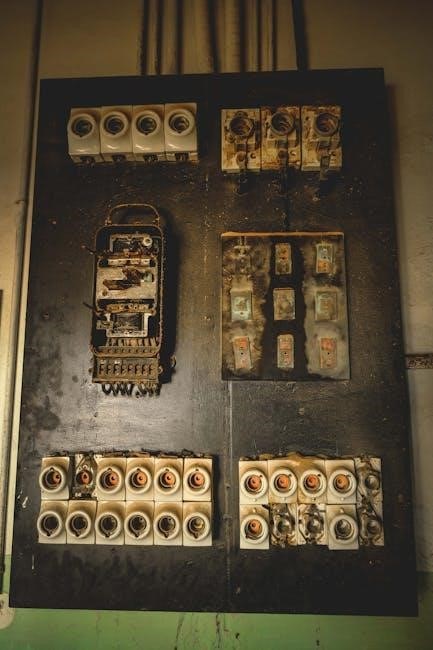
Using undersized wires can create a fire hazard, while oversized wires are unnecessarily expensive and difficult to work with.
Tools Required for Installation
Successful 3-way switch wiring, guided by a 3-way switch wiring diagram PDF, necessitates having the correct tools readily available.
Essential tools include wire strippers for safely removing insulation without damaging the conductors.
A voltage tester is crucial for verifying power is OFF before commencing any wiring work, ensuring safety.
Screwdrivers (flathead and Phillips) are needed for securing switches and mounting brackets.
Pliers are useful for bending and manipulating wires, as well as making secure connections.
A multimeter aids in troubleshooting and verifying circuit continuity, as detailed in some diagrams.
Electrical tape provides insulation for exposed wire connections, enhancing safety.
Safety glasses protect your eyes from debris, and work gloves offer grip and protection.
Having a flashlight or headlamp illuminates dark work areas, improving visibility during installation;

Step-by-Step Wiring Diagram Analysis
Diagrams are essential for understanding 3-way switch wiring; careful analysis reveals power source, common terminals, and traveler wire connections.
A 3-way switch wiring diagram PDF simplifies complex circuits, offering a visual guide for successful installation and troubleshooting.
Identifying the Power Source (Line)
Locating the power source, often termed the “line” wire, is the crucial first step when analyzing a 3-way switch wiring diagram PDF. This wire delivers electricity from the electrical panel to the circuit. Typically, it’s a black wire, but always verify with a non-contact voltage tester before making any connections.

The diagram will illustrate where the line wire enters the circuit – it could be at the first switch, the second switch, or even at the light fixture itself. Understanding this initial point is fundamental. Carefully trace the wiring path on the diagram to confirm the line wire’s origin.
Incorrectly identifying the line wire can lead to a non-functional circuit or, more dangerously, a short circuit. Always double-check your findings against the diagram and use a multimeter for confirmation if needed. Remember to turn off the breaker before any wiring work!
Connecting the Common Terminals
The common terminals on 3-way switches are key to understanding the circuit’s functionality, as depicted in a 3-way switch wiring diagram PDF. These are typically darker-colored screws, often black or copper, and serve as the entry/exit points for the power flow.
The line wire (power source) connects to the common terminal of one switch, while the wire leading to the light fixture connects to the common terminal of the other switch. The diagram clearly shows this distinction. Ensure secure connections using appropriate wire connectors.
Properly connecting the common terminals is vital for the switches to alternate the circuit. Incorrect connections will prevent the lights from operating correctly. Refer to the diagram and double-check your work before restoring power. A reliable connection ensures safe and effective operation.
Wiring the Traveler Wires
Traveler wires are crucial for enabling control of a light from two locations, and a 3-way switch wiring diagram PDF visually demonstrates their connection. These wires, typically red and another color, connect the two 3-way switches, forming the alternating path for electricity.
Connect the traveler wires to the remaining terminals on each switch – these are usually lighter-colored screws. It doesn’t matter which traveler wire goes to which terminal, as long as they are paired consistently between the two switches, as shown in the diagram.
Securely connecting the traveler wires ensures the switches can effectively “talk” to each other, allowing either switch to turn the light on or off. Incorrect wiring of travelers will result in unpredictable behavior. Always consult the diagram for accurate connections.
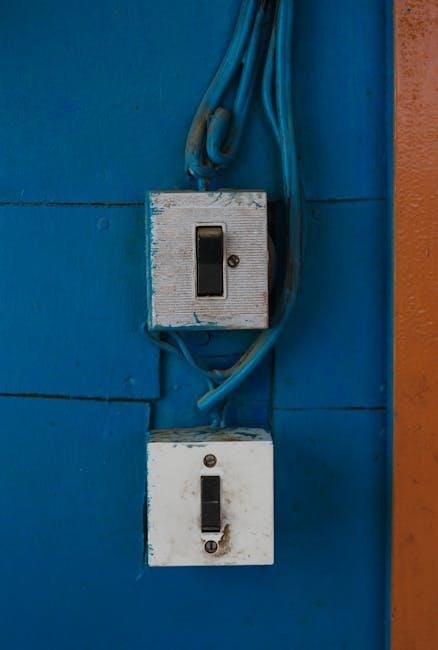
Common 3-Way Switch Configurations
Various 3-way switch setups exist, detailed in a diagram PDF, depending on power source location—fixture, first switch, or second switch.
Understanding these configurations is vital for correct installation and functionality, as illustrated in residential wiring diagrams.
Scenario 1: Power Source at the Light Fixture
When the power source is located at the light fixture, the 3-way switch wiring diagram PDF reveals a specific configuration. This setup typically involves running a cable from the power source to the light fixture, then separate cables extending from the fixture to each 3-way switch.
The neutral wire from the power source connects directly to the light fixture’s neutral terminal. The hot wire connects to the fixture’s hot terminal, and the ground wire is connected to the fixture’s ground screw. From the light fixture, two “traveler” wires run to the common terminals of both 3-way switches.
Crucially, the line (hot) wire isn’t directly connected to either switch in this scenario. Instead, the switches control the flow of power to the light fixture via the traveler wires. A diagram clearly illustrates this pathway, emphasizing the importance of correctly identifying the common and traveler terminals on each switch for proper operation. This configuration is often favored for its simplicity in certain installations.
Scenario 2: Power Source at the First Switch
A 3-way switch wiring diagram PDF demonstrates a distinct approach when the power source originates at the first switch location. Here, the hot wire from the power source connects to the common terminal of the first 3-way switch. A cable then runs from this switch to the second 3-way switch, carrying two traveler wires.
The second switch’s common terminal connects to the hot wire leading to the light fixture. Neutral wires run directly from the power source to the light fixture. Ground wires are connected appropriately at each location – power source, switches, and fixture – ensuring safety.
The diagram highlights that the first switch effectively acts as the primary controller, interrupting or completing the circuit to the second switch. Correctly identifying the line, common, and traveler terminals is paramount. This configuration is common in new construction or renovations, offering a straightforward wiring path as illustrated in detailed diagrams.
Scenario 3: Power Source at the Second Switch
A 3-way switch wiring diagram PDF reveals a more complex setup when the power source is located at the second switch. In this scenario, the hot wire from the power source connects to the common terminal of the second 3-way switch. A cable runs from the first switch to the second, utilizing two traveler wires for communication.
The first switch’s common terminal connects to the light fixture via another cable. Crucially, the neutral wire runs directly from the power source to the light fixture, bypassing the first switch. Proper grounding is essential at all points: power source, both switches, and the light fixture.
Diagrams emphasize that the second switch, receiving power directly, becomes the primary control point. This configuration often arises during renovations or when adding a 3-way switch to an existing circuit. Careful attention to wire connections, as shown in the diagram, is vital for safe and functional operation.

Troubleshooting 3-Way Switch Circuits
A 3-way switch wiring diagram PDF aids in diagnosing issues; common problems include loose connections or incorrectly wired traveler wires.
Using a multimeter, verify voltage and continuity, referencing the diagram to pinpoint faults within the circuit’s complex wiring.
Common Wiring Mistakes
Incorrectly identifying the common terminal is a frequent error when referencing a 3-way switch wiring diagram PDF, leading to non-functional circuits.
Miswiring the traveler wires disrupts the alternating path, preventing control from both switch locations; careful attention to the diagram is crucial.

Failing to properly ground the switches poses a significant safety hazard, bypassing essential protection against electrical shock.
Loose wire connections create intermittent issues or complete circuit failure, necessitating secure tightening of all terminals.
Confusing the line and load wires can damage the fixture or switches, emphasizing the importance of accurate identification using the diagram.
Not turning off the power before wiring is extremely dangerous, highlighting the necessity of safety precautions.
Using incorrect wire gauges can lead to overheating and potential fire hazards, requiring adherence to electrical code standards.
Always double-check against the diagram!
Using a Multimeter for Testing
A multimeter is invaluable for verifying 3-way switch wiring, especially when referencing a 3-way switch wiring diagram PDF for expected readings.
Testing for voltage at the line terminal confirms power supply, ensuring the circuit is energized before further checks.
Continuity testing between traveler terminals helps identify correct connections, validating the alternating path described in the diagram.
Checking for shorts between wires prevents potential hazards, ensuring no unintended connections exist.
Verifying the common terminal’s connection to the light fixture confirms proper circuit completion.
Measuring resistance can indicate faulty switches or loose connections, pinpointing issues not visible to the eye.
Always ensure power is OFF before testing continuity, and exercise caution when working with live circuits.
Refer to the diagram to understand expected voltage and resistance values for accurate troubleshooting.

Safety Precautions
Always disconnect power at the breaker before wiring, referencing a 3-way switch wiring diagram PDF for guidance.
Proper grounding is crucial for safety, preventing electrical shock and ensuring circuit protection during installation.
Turning Off Power Before Wiring
Before commencing any 3-way switch wiring, meticulously locate the circuit breaker controlling the intended circuit, often referencing a 3-way switch wiring diagram PDF.
Completely switch the breaker to the “OFF” position; do not rely solely on the switch itself to interrupt power flow, as this is insufficient for safe work.
Utilize a non-contact voltage tester to verify the absence of power at all wires involved in the wiring process, confirming the breaker’s effectiveness.
This crucial step prevents accidental electrical shock and potential damage to components during installation or troubleshooting.
Double-check your work, and if unsure about identifying the correct breaker, consult a qualified electrician before proceeding with any wiring tasks.
Ignoring this precaution can lead to severe injury or even fatal consequences, emphasizing the importance of prioritizing safety above all else.
Grounding Considerations
Proper grounding is paramount when working with electrical wiring, including 3-way switch installations, and is often detailed in a 3-way switch wiring diagram PDF.
Ensure all metal electrical boxes are securely grounded, providing a safe path for fault current in case of a short circuit.
Connect the bare copper or green grounding wire to the grounding screw within the metal box and to the grounding terminal on each switch.
This grounding connection minimizes the risk of electrical shock and protects against potential fire hazards.
Never disconnect or bypass grounding wires, as this compromises the safety of the entire electrical system.
Always verify grounding continuity with a multimeter to confirm a secure and effective ground connection before restoring power.
Adhering to these grounding practices, as illustrated in diagrams, is essential for a safe and code-compliant 3-way switch installation.