
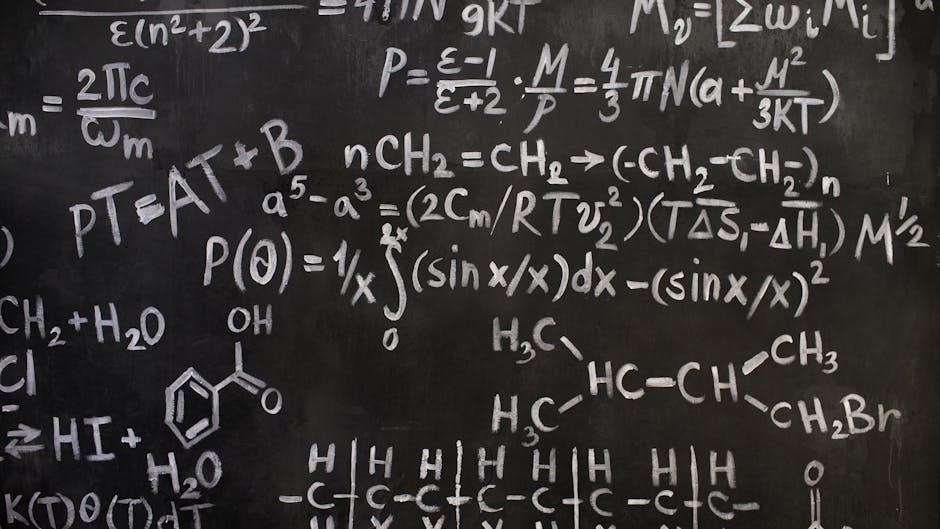
Article Plan: College Algebra & Trigonometry PDF
This comprehensive guide explores utilizing PDF textbooks for mastering college algebra and trigonometry, covering core topics, resources, and effective study strategies․

College Algebra and Trigonometry represent a crucial stepping stone in a student’s mathematical journey, often serving as a gateway to higher-level STEM courses․ This combined course builds upon foundational algebraic principles while introducing the fascinating world of trigonometric functions and their applications․ Many students encounter this as a terminal course, solidifying essential skills․
The availability of these courses in PDF format offers a flexible and accessible learning experience․ These digital textbooks, like those from OpenStax and MathCity․org, provide a cost-effective alternative to traditional printed materials; Understanding the core concepts – from algebraic expressions to trigonometric identities – is vital, and PDFs can be a powerful tool in achieving mastery․ This guide will explore the benefits and challenges of using PDF textbooks for College Algebra & Trigonometry․
What is College Algebra?

College Algebra is a branch of mathematics focused on manipulating symbols and solving equations to represent unknown quantities․ It extends high school algebra, delving deeper into algebraic expressions, equations, inequalities, and functions․ This course often serves as preparation for calculus and other advanced mathematics․
Unlike elementary algebra, college algebra emphasizes a more abstract and theoretical approach․ Students learn to analyze and interpret functions graphically and algebraically, mastering concepts like polynomial, rational, and exponential functions․ Utilizing a PDF textbook allows for convenient access to these concepts, enabling students to practice problem-solving and reinforce their understanding at their own pace․ It’s a derivative of Precalculus, designed for a broad range of students․
What is Trigonometry?
Trigonometry is the study of relationships between angles and sides of triangles, primarily right triangles․ It’s a crucial branch of mathematics with applications in fields like physics, engineering, and navigation․ Core concepts include the six trigonometric ratios (sine, cosine, tangent, and their reciprocals), the unit circle, and trigonometric identities․
Students learn to solve triangles using the Law of Sines and Cosines, and to understand circular and graphical trigonometry․ A PDF textbook provides a flexible way to explore these concepts, offering detailed explanations and practice problems․ It builds upon the foundation of algebra, applying algebraic principles to geometric shapes and relationships, often covered in introductory units․
Why Use a PDF Textbook?
PDF textbooks offer numerous advantages for students studying college algebra and trigonometry․ They are often more affordable than traditional printed books, and many free resources are available online, like those from MathCity․org․ PDFs are portable, accessible on various devices – laptops, tablets, and smartphones – allowing study anytime, anywhere․
Digital formats enable convenient searching, highlighting, and note-taking․ Features like zoom functionality aid in understanding complex graphs and equations․ While potential drawbacks exist (discussed later), the accessibility and cost-effectiveness of PDFs make them a compelling option for mastering these foundational mathematical concepts, supplementing coursework and providing ample practice opportunities․
Popular College Algebra & Trigonometry PDF Textbooks

Several excellent PDF textbooks are available for college algebra and trigonometry․ OpenStax College Algebra and Trigonometry is a widely used, free, and openly licensed resource․ Textbook of Algebra and Trigonometry for Class XI (MathCity․org) provides focused exercises, like those in Exercise 2;2, for targeted practice․
Stepping Stones to Math Workbooks offer a precalculus introduction, bridging the gap to advanced college-level mathematics․ These workbooks cover essential topics, including right, circular, and graphical trigonometry․ Exploring these options allows students to find a resource that best suits their learning style and course requirements, enhancing comprehension and success․
OpenStax College Algebra and Trigonometry
OpenStax offers a free, peer-reviewed, and openly licensed College Algebra and Trigonometry PDF textbook, making it a highly accessible resource for students․ This comprehensive text covers fundamental algebraic concepts, quadratic equations, polynomial and rational functions, and a robust introduction to trigonometry․
It’s designed for broad appeal, serving both first and second-year college students․ The textbook’s structure often aligns with typical course syllabi, including units on trigonometric identities, solving triangles, and exponential functions․ Its digital format allows for easy navigation, searching, and printing, providing a cost-effective alternative to traditional textbooks․
Textbook of Algebra and Trigonometry for Class XI (MathCity․org)
MathCity․org provides a Textbook of Algebra and Trigonometry specifically designed for Class XI students, available as a PDF resource․ This textbook focuses on building a strong foundation in algebraic expressions, equations, and trigonometric principles․ It includes detailed exercises, like Exercise 2․2, designed to reinforce learning and problem-solving skills․

The material serves as a stepping stone towards more advanced precalculus and college-level mathematics․ It covers introductory trigonometry, solving triangles using various methods, and exploring trigonometric identities․ This resource is particularly useful for students seeking supplementary materials or a different approach to understanding core concepts․
Stepping Stones to Math Workbooks
Stepping Stones to Math offers workbooks designed to bridge the gap between algebra and precalculus, providing a solid foundation for college-level trigonometry․ These resources focus on building conceptual understanding through practice and reinforcement, covering essential topics like right, circular, and graphical trigonometry․
The workbooks are structured to introduce students to advanced mathematical concepts gradually․ They aim to prepare learners for the rigors of college mathematics, including exponential functions and trigonometric identities․ These materials are valuable supplements for students needing extra practice or a different learning style, enhancing their overall comprehension and problem-solving abilities․
Core Topics Covered in College Algebra
College Algebra forms the foundational basis for trigonometry and further mathematical studies, focusing on manipulating and solving mathematical expressions․ Key areas include mastering algebraic expressions and equations, learning to simplify, factor, and solve for unknown variables․
A significant portion is dedicated to quadratic equations and functions, encompassing factoring, completing the square, and utilizing the quadratic formula․ Furthermore, students delve into polynomial and rational functions, exploring their graphs, roots, and behaviors․ These concepts are crucial for understanding more complex functions encountered in trigonometry and calculus, building a strong analytical skillset․
Algebraic Expressions and Equations
This foundational topic in College Algebra centers on representing mathematical relationships using symbols and variables; Students learn to simplify expressions by combining like terms and applying the order of operations․ A core skill is solving equations – linear, quadratic, and beyond – to isolate variables and find their values․
Understanding factoring techniques is paramount, enabling the simplification of expressions and the solving of equations․ The ability to manipulate algebraic expressions is essential for tackling more advanced concepts, including functions and graphing․ Mastering these skills provides a crucial building block for success in trigonometry and subsequent mathematical coursework․

Quadratic Equations and Functions
Quadratic equations and functions represent a pivotal concept in College Algebra, extending beyond simple linear relationships․ Students explore various methods for solving quadratic equations, including factoring, completing the square, and utilizing the quadratic formula․ Understanding the discriminant reveals the nature of the roots – real, distinct, or complex․
Furthermore, the study encompasses graphing quadratic functions, identifying key features like the vertex, axis of symmetry, and intercepts․ This visual representation solidifies understanding and allows for applications in modeling real-world scenarios․ Proficiency in quadratic functions is crucial for success in precalculus and related fields․
Polynomial and Rational Functions
Polynomial functions, extending from linear and quadratic forms, are a core component of College Algebra․ Students learn to identify their degree, leading coefficient, and end behavior, crucial for sketching graphs․ Factoring polynomials and finding their zeros are essential skills, alongside understanding multiplicity and the Intermediate Value Theorem․
Rational functions, defined as ratios of polynomials, introduce concepts like vertical, horizontal, and slant asymptotes․ Analyzing these functions requires determining domain restrictions and understanding how they impact the graph․ Mastering polynomial and rational functions builds a strong foundation for calculus and advanced mathematical modeling․

Core Topics Covered in Trigonometry
Trigonometry delves into the relationships between angles and sides of triangles, primarily right triangles, forming the basis for understanding circular functions․ Initial exploration focuses on defining the six trigonometric ratios – sine, cosine, tangent, and their reciprocals – and applying them to solve for unknown sides and angles․
Further study expands to the unit circle, enabling the evaluation of trigonometric functions for all angles, not just acute ones․ Trigonometric identities are then introduced, providing tools to simplify expressions and solve equations․ Finally, students learn to apply the Law of Sines and Cosines to solve non-right triangles․
The foundation of trigonometry begins with right triangles, where the relationships between sides and angles are meticulously examined․ This involves defining the three primary trigonometric ratios – sine, cosine, and tangent – as ratios of sides (opposite, adjacent, hypotenuse) relative to a specific acute angle․
Understanding these ratios allows for the calculation of unknown angles or side lengths when given sufficient information․ Students learn to apply SOH CAH TOA as a mnemonic device․ This initial exploration provides the groundwork for more complex trigonometric concepts, including the unit circle and trigonometric identities, building a strong base for further study․

Circular Trigonometry and Unit Circle
Expanding beyond right triangles, circular trigonometry utilizes the unit circle – a circle with a radius of one – to define trigonometric functions for all angles, not just acute ones․ This approach allows for the visualization of periodic functions and extends the definitions of sine, cosine, tangent, and their reciprocals․
The coordinates of points on the unit circle directly correspond to cosine and sine values, respectively, for a given angle․ Understanding the unit circle is crucial for grasping concepts like radian measure, periodic functions, and solving trigonometric equations․ It provides a powerful tool for analyzing trigonometric behavior and lays the groundwork for advanced mathematical applications․
Trigonometric Identities
Trigonometric identities are equations that hold true for all values of the variables involved, forming the bedrock of advanced trigonometry and calculus․ These identities, such as Pythagorean, reciprocal, quotient, and sum/difference formulas, allow for the simplification of complex expressions and the solving of trigonometric equations․
Mastering these identities is essential for manipulating trigonometric functions, proving other identities, and tackling challenging problems․ A strong grasp of identities enables students to rewrite expressions in more convenient forms, facilitating calculations and deeper understanding․ Utilizing PDF resources often provides extensive practice problems to solidify this crucial skill set․
Solving Triangles (Law of Sines & Cosines)
Applying the Law of Sines and Cosines is fundamental to solving non-right triangles, a core skill within trigonometry․ These laws establish relationships between a triangle’s angles and side lengths, enabling calculations of unknown sides or angles when sufficient information is provided․
PDF textbooks often dedicate significant sections to practical applications, including real-world problems involving surveying, navigation, and engineering․ Understanding when to apply each law – Sine for angle-angle-side or side-angle-angle, and Cosine for side-side-side or side-angle-side – is crucial․ Practice within a PDF format allows for repeated problem-solving, reinforcing these concepts effectively․
Finding Free College Algebra & Trigonometry PDFs
Locating free, legal College Algebra & Trigonometry PDFs requires careful navigation․ OpenStax offers a widely-used, openly licensed textbook available for free download, providing a comprehensive resource․ MathCity․org provides materials, including textbooks for Class XI, potentially offering foundational content․
However, exercise caution when sourcing PDFs online․ Ensure the source is reputable to avoid copyright infringement or malware․ Websites offering “free” textbooks may contain illegal copies or compromised files․ Utilizing university open courseware or library digital collections are also viable options for accessing legitimate PDF versions of these essential texts․
Legal Considerations When Using PDF Textbooks
Utilizing PDF textbooks necessitates awareness of copyright laws․ Downloading copyrighted material without permission is illegal․ Openly licensed textbooks, like those from OpenStax, are specifically designed for free distribution and use, eliminating legal concerns․
When sourcing PDFs online, verify the legitimacy of the source․ Websites offering textbooks without clear licensing information should be avoided․ Educational institutions often have agreements allowing students access to digital texts; adhere to those policies․ Respecting intellectual property rights is crucial, and using legally obtained PDFs ensures ethical and lawful study practices within college algebra and trigonometry․
Advantages of Digital Textbooks (PDFs)
PDF textbooks offer significant advantages for college algebra and trigonometry students․ Portability is key – access materials on any device, anywhere․ Cost savings are substantial, especially with free options like OpenStax․ PDFs facilitate easy searching for specific concepts and terms, boosting study efficiency․

Digital formats enable features like zooming, highlighting, and note-taking directly within the text․ Environmentally friendly, PDFs reduce paper consumption․ Furthermore, many PDFs are accessible on various platforms, promoting flexible learning․ These benefits collectively enhance the learning experience and make mastering complex mathematical concepts more achievable․
Disadvantages of Digital Textbooks (PDFs)
While advantageous, PDF textbooks also present certain drawbacks for college algebra and trigonometry learners․ Eye strain and fatigue can occur with prolonged screen time, impacting concentration․ Digital distractions, like notifications, can hinder focused study sessions․ Dependence on technology means access is lost without a device or power source․
Some PDFs may lack interactive features found in traditional textbooks, potentially limiting understanding of graphical concepts․ Concerns regarding copyright and illegal distribution exist․ Furthermore, navigating lengthy PDFs can sometimes be cumbersome․ These limitations should be considered when choosing between digital and physical learning materials․
Utilizing PDFs for Effective Study
Maximizing learning from college algebra & trigonometry PDFs requires strategic approaches․ Utilize PDF annotation tools to highlight key concepts, define terms, and add personal notes directly onto the pages․ Employ search functions to quickly locate specific formulas or examples․ Break down large PDFs into smaller, manageable sections for focused study sessions․
Regularly review annotated notes and practice problems․ Consider printing key chapters for offline access and reduced screen time․ Supplement PDF study with online resources and practice quizzes․ Active engagement with the material, rather than passive reading, is crucial for success․
Supplementary Resources for College Algebra & Trigonometry
Beyond PDF textbooks, numerous resources bolster understanding․ Websites like MathCity․org offer supplementary materials and exercise solutions, aiding comprehension of concepts like trigonometric identities and solving triangles․ Stepping Stones to Math workbooks provide focused practice on precalculus and advanced topics, bridging gaps in knowledge․
Khan Academy delivers free video tutorials and practice exercises covering algebra and trigonometry fundamentals․ Utilize online graphing calculators to visualize functions and solutions․ Explore interactive simulations to grasp circular trigonometry and the unit circle․ Remember to cross-reference information and seek diverse explanations for a robust learning experience․
The Role of Precalculus in Preparation
Precalculus serves as a foundational stepping stone to College Algebra & Trigonometry․ It meticulously reviews algebraic manipulation skills – essential for tackling complex equations and functions․ The workbook from Stepping Stones to Math specifically introduces precalculus mathematics, preparing students for advanced college-level coursework․
A strong grasp of precalculus concepts, including functions, graphing, and basic trigonometry, significantly eases the transition․ It builds the necessary analytical thinking and problem-solving abilities․ College Algebra, often a derivative of Precalculus, benefits from this prior knowledge, allowing students to focus on new, more intricate material․
Applied Mechanics and Trigonometry Connections
Trigonometry isn’t confined to abstract mathematics; it’s fundamentally linked to applied mechanics․ Historically, texts like “Lessons in Applied Mechanics” by Cotterill and Slade (1891) demonstrate this connection, utilizing trigonometric principles to analyze forces, resolve vectors, and understand structural stability․
Understanding the relationships between angles and sides of triangles – a core trigonometric concept – is crucial for calculating loads, stresses, and movements in mechanical systems․ Right triangle trigonometry, in particular, provides the basis for resolving forces into components․ This practical application highlights trigonometry’s real-world relevance beyond theoretical exercises․
The Six Trigonometric Ratios Explained
Trigonometry fundamentally explores the relationships between angles and sides of right triangles, defined by six key ratios: sine, cosine, tangent, cosecant, secant, and cotangent․ These ratios, often remembered using mnemonics, express these relationships․
Sine (opposite/hypotenuse), cosine (adjacent/hypotenuse), and tangent (opposite/adjacent) are primary ratios․ The remaining three are reciprocals: cosecant (1/sine), secant (1/cosine), and cotangent (1/tangent)․ Mastering these ratios is essential for solving problems involving angles and distances․ Resources like freely available PDF documents detail these concepts, providing examples and practice exercises to solidify understanding․
Exponential Functions in Trigonometry
Exponential functions frequently appear within trigonometric contexts, particularly when modeling periodic phenomena like oscillations and wave behavior․ Understanding their interplay is crucial for advanced problem-solving․
For instance, exponential growth or decay can modify the amplitude or frequency of trigonometric functions․ PDF textbooks often demonstrate this through applications in physics and engineering, showcasing how exponential terms affect wave propagation or damping․ Concepts like Euler’s formula (eix = cos(x) + i sin(x)) elegantly connect exponential and trigonometric functions, forming the basis for complex number analysis․ Accessing detailed explanations within downloadable PDFs aids comprehension of these interconnected mathematical ideas․
Understanding Graphical Trigonometry
Graphical trigonometry visually represents trigonometric functions, revealing their periodic nature, amplitude, phase shifts, and vertical translations․ PDF textbooks excel at providing clear, detailed graphs alongside explanations․
Students can utilize these visual aids to grasp concepts like the unit circle and the relationships between sine, cosine, and tangent․ Interactive PDF features, if available, might allow manipulation of graphs to observe the effects of changing parameters․ Understanding graphical representations is vital for solving trigonometric equations and interpreting real-world applications․ High-quality PDFs often include practice problems with solutions, reinforcing the connection between algebraic expressions and their corresponding graphical forms, ultimately enhancing comprehension․
Common Challenges in College Algebra & Trigonometry
Many students struggle with the abstract nature of algebraic manipulation and the numerous formulas in trigonometry․ A key challenge lies in transitioning from arithmetic to symbolic reasoning, requiring strong foundational skills․
Trigonometric identities often present a hurdle, demanding memorization and skillful application․ Difficulty visualizing concepts, particularly with graphs, is also common․ Utilizing a PDF textbook allows for repeated review and focused practice on problem areas․ Students may find it challenging to connect algebra and trigonometry concepts, hindering problem-solving abilities․ PDFs with worked examples and step-by-step solutions can mitigate these difficulties, fostering a deeper understanding․
Tips for Success in the Course
Consistent practice is paramount; work through numerous problems using your College Algebra & Trigonometry PDF textbook․ Actively engage with the material, don’t just passively read․
Utilize the search function within your PDF to quickly locate specific concepts or examples․ Form study groups to discuss challenging topics and share problem-solving strategies․ Leverage online resources alongside your PDF, such as MathCity․org for supplementary exercises․ Break down complex problems into smaller, manageable steps․ Regularly review previous material to reinforce understanding․ Don’t hesitate to seek help from instructors or tutors when needed, and remember to focus on graphical understanding․
Utilizing College Algebra & Trigonometry PDFs offers a flexible and cost-effective path to success․ These digital resources, like those from OpenStax and MathCity․org, provide comprehensive coverage of essential topics – from algebraic expressions to trigonometric identities․
Remember that consistent practice, coupled with supplementary resources and a solid grasp of precalculus concepts, is key․ PDFs facilitate efficient study through searchability and portability․ While challenges exist, the advantages of digital textbooks are significant․ Embrace the power of these tools, and with dedication, you can confidently master the intricacies of college algebra and trigonometry, building a strong foundation for future mathematical endeavors․