
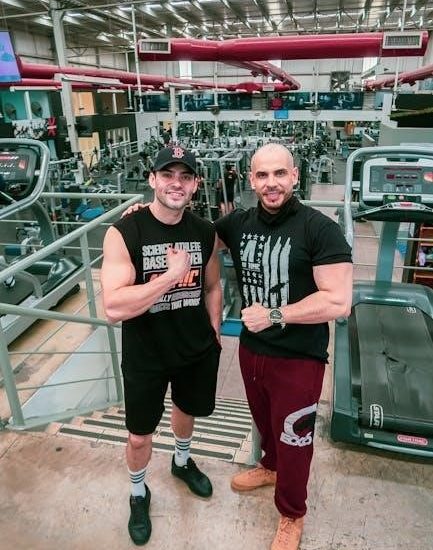
Bradley Martyn Get Lean PDF: A Comprehensive Guide
Bradley Martyn’s “Get Lean” program‚ detailed in the readily available PDF‚ is a meticulously structured 6-day split designed for maximizing fat loss while diligently preserving hard-earned muscle mass.
Bradley Martyn’s “Get Lean” program‚ often circulated as a PDF‚ represents a focused approach to body recomposition – simultaneously shedding fat and maintaining‚ or even building‚ muscle. This isn’t a bulk-focused plan; it’s specifically tailored for individuals aiming to achieve a leaner physique. The program’s core lies in a six-day-per-week training split‚ strategically designed to optimize both performance and recovery while operating within a calorie deficit.
The PDF details a New Year’s cut workout plan‚ emphasizing high-intensity training coupled with thoughtful recovery protocols. It’s built around the principle that consistent‚ challenging workouts‚ when paired with proper nutrition‚ are the key to unlocking significant physique changes. The program isn’t just about lifting weights; it incorporates dynamic cardio and a unique barbell complex routine to enhance conditioning and overall fat burning. It’s a comprehensive system intended to deliver noticeable results for those committed to the process.
The Core Philosophy: Maximizing Fat Loss & Muscle Retention

The central tenet of Bradley Martyn’s “Get Lean” program‚ as outlined in the PDF‚ revolves around achieving a delicate balance: aggressive fat loss without sacrificing valuable muscle mass. This is accomplished not through extreme measures‚ but through a strategic combination of intense training‚ a calculated calorie deficit‚ and optimized recovery. The program acknowledges that simply cutting calories can lead to muscle loss‚ therefore‚ the workout split is designed to provide sufficient stimulus for muscle retention.
The philosophy prioritizes maintaining training intensity even while in a deficit. The six-day split allows for focused work on specific muscle groups‚ followed by strategic cardio and conditioning. This approach aims to maximize metabolic stress and calorie expenditure‚ driving fat loss while minimizing the catabolic effects of dieting. It’s about working with your body‚ not against it‚ to achieve sustainable and aesthetically pleasing results.
Program Overview: 6-Day Split & Calorie Deficit
Bradley Martyn’s “Get Lean” program‚ detailed in the PDF‚ is structured around a rigorous 6-day training split‚ allocating one day for complete rest and recovery. The weekly schedule systematically targets different muscle groups: Back & Chest‚ Dynamic Cardio‚ Shoulders & Arms‚ Legs‚ and a full-body Barbell Complex routine. This cyclical approach ensures comprehensive muscle stimulation and prevents overtraining.
Crucially‚ the program operates under a consistent calorie deficit. While the specific deficit isn’t detailed in the source‚ it’s implied as fundamental to the fat loss component. The workout schedule is intentionally designed to complement this deficit‚ maximizing calorie expenditure through high-intensity training and strategic cardio integration. The order of muscle group training and cardio days is optimized to facilitate recovery while maintaining a demanding workload‚ ultimately driving fat loss and preserving lean muscle.

Workout Structure & Muscle Group Focus
The “Get Lean” PDF outlines a focused six-day split‚ strategically grouping muscle workouts and cardio to optimize intensity‚ recovery‚ and overall fat-loss results.
Day 1: Back & Chest – Compound Movements
Day one of the “Get Lean” program‚ as detailed in the PDF‚ centers around a powerful back and chest workout emphasizing compound movements. This approach is crucial for maximizing calorie expenditure and stimulating significant muscle activation. Expect a focus on exercises like barbell rows‚ pull-ups (or lat pulldowns)‚ and various chest presses – both flat and inclined.
The selection of compound lifts isn’t accidental; they engage multiple muscle groups simultaneously‚ boosting metabolic demand and promoting hormonal responses favorable for fat loss and muscle retention. Bradley Martyn’s philosophy prioritizes efficiency‚ and these movements deliver substantial results in a relatively short timeframe. The PDF likely includes specific set and rep schemes‚ but the core principle remains: heavy lifting with controlled form to build strength and burn calories. This foundational workout sets the tone for the week‚ preparing the body for subsequent training sessions.
Day 2: Dynamic Cardio – HIIT & LISS Integration
Following the intense weightlifting of Day 1‚ Day 2 of the “Get Lean” PDF focuses on dynamic cardio‚ strategically integrating both High-Intensity Interval Training (HIIT) and Low-Intensity Steady State (LISS) methods. This dual approach maximizes fat burning potential while minimizing the risk of overtraining and muscle breakdown.
HIIT sessions‚ likely involving sprints or burpees‚ are designed to elevate the heart rate rapidly‚ creating an “afterburn” effect that continues to consume calories long after the workout is complete. Complementing HIIT‚ LISS – such as brisk walking or incline treadmill work – provides a sustained cardiovascular stimulus without placing excessive stress on the body. The PDF likely outlines specific durations and intensities for each cardio type‚ tailored to support the overall calorie deficit and recovery process. This balanced cardio strategy is key to Martyn’s lean-building approach.
Day 3: Shoulders & Arms – Isolation & Volume
Dedicated to sculpting well-defined shoulders and arms‚ Day 3 within the “Get Lean” PDF emphasizes both isolation exercises and high training volume. This approach aims to maximize muscle hypertrophy – growth – while simultaneously contributing to increased calorie expenditure. Expect a focus on exercises that directly target the deltoids (front‚ side‚ and rear) and the biceps and triceps.
The program likely incorporates a variety of movements‚ ranging from dumbbell lateral raises and front raises for shoulder development‚ to bicep curls and triceps extensions for arm definition. Bradley Martyn’s methodology often favors higher rep ranges to induce metabolic stress‚ promoting a pump and enhancing muscle endurance. The PDF probably details specific sets‚ reps‚ and rest periods to optimize results within the context of the overall calorie deficit‚ ensuring muscle retention during the cutting phase.
Day 4: Legs – Strength & Hypertrophy
Leg day within Bradley Martyn’s “Get Lean” program‚ as outlined in the PDF‚ is a crucial component focused on building both strength and muscle mass in the lower body. This session likely incorporates a blend of compound exercises – movements that work multiple muscle groups simultaneously – and isolation work to comprehensively target the quads‚ hamstrings‚ glutes‚ and calves.

Expect to find exercises like squats‚ leg presses‚ and Romanian deadlifts forming the foundation of this workout‚ promoting overall lower body strength and power. Higher volume work‚ such as leg extensions and hamstring curls‚ will likely be included to enhance muscle hypertrophy and definition. The program’s design‚ within a calorie deficit‚ aims to preserve lean muscle tissue while maximizing fat loss‚ making leg day a vital element for maintaining a balanced physique.

Advanced Training Techniques
Bradley Martyn’s “Get Lean” PDF incorporates techniques like barbell complexes for full-body conditioning‚ alongside a strong emphasis on progressive overload for continuous gains.
Day 5: Barbell Complex Routine – Full Body Conditioning
Day 5 of the “Get Lean” program‚ as outlined in the PDF‚ centers around a challenging barbell complex routine. This isn’t your typical lifting session; it’s designed as a full-body conditioning element‚ pushing endurance and metabolic rate. The complex involves performing a series of exercises – typically 5-6 – consecutively without putting the barbell down.
Exercises often include Romanian deadlifts‚ bent-over rows‚ cleans‚ push presses‚ and back squats‚ performed with a moderate weight. The goal isn’t maximal strength‚ but rather maintaining tension and moving efficiently through each exercise. Completing multiple rounds of this complex elevates the heart rate‚ burns significant calories‚ and improves overall conditioning.
This day strategically follows heavier lifting days‚ serving as active recovery while still providing a substantial stimulus. It’s a key component in maximizing fat loss and enhancing work capacity‚ aligning with the program’s core philosophy of intense training coupled with strategic recovery.
The Role of Progressive Overload
Progressive overload is a cornerstone principle within Bradley Martyn’s “Get Lean” program‚ detailed in the PDF. While operating within a calorie deficit‚ simply maintaining the same weight and reps won’t yield continued results. The program emphasizes consistently challenging the muscles to stimulate adaptation and prevent plateaus.
This isn’t always about adding weight; it can involve increasing repetitions‚ reducing rest times‚ improving exercise technique‚ or adding sets. The key is to incrementally increase the demand placed on the body over time. This forces the muscles to become stronger and more efficient‚ even while fat loss is occurring.
The PDF implicitly encourages tracking workouts to monitor progress and ensure overload is being implemented effectively. Consistent application of this principle is crucial for preserving muscle mass during a cut and maximizing the overall effectiveness of the “Get Lean” program.
Importance of Proper Form & Technique

Bradley Martyn’s “Get Lean” PDF implicitly stresses the paramount importance of maintaining impeccable form and technique throughout all exercises. The program’s intensity‚ even within a calorie deficit‚ demands a focus on controlled movements to minimize the risk of injury and maximize muscle activation.
Compromised form not only reduces the effectiveness of each repetition but also significantly increases the likelihood of strains‚ sprains‚ or more serious injuries. The 6-day split‚ with its emphasis on compound and isolation movements‚ requires precise execution to target the intended muscle groups effectively.
Prioritizing technique over ego – lifting heavier weights at the expense of form – is crucial for long-term progress and sustainability. The PDF‚ while outlining the workout structure‚ assumes a base level of understanding regarding proper exercise execution.

Nutrition & Supplementation
Bradley Martyn’s “Get Lean” PDF centers around a strategic calorie deficit‚ coupled with precise macronutrient ratios and potentially‚ supplementation to support fat loss and muscle retention.
Calorie Deficit Strategies for Optimal Fat Loss

Bradley Martyn’s “Get Lean” program fundamentally relies on establishing and maintaining a consistent calorie deficit to effectively promote fat loss. The PDF emphasizes that this isn’t about drastic restriction‚ but rather a calculated reduction from your Total Daily Energy Expenditure (TDEE).

A moderate deficit‚ typically between 300-500 calories per day‚ is recommended to encourage fat loss without significantly compromising muscle mass or hindering recovery from intense training. It’s crucial to accurately calculate your TDEE‚ factoring in activity levels‚ and then strategically reduce caloric intake.
The program doesn’t prescribe a specific calorie number‚ recognizing individual needs vary. Instead‚ it advocates for consistent tracking of food intake and monitoring of weight loss progress. Adjustments to the calorie deficit should be made based on individual responses‚ ensuring sustainable and healthy fat loss over time. Prioritizing whole‚ unprocessed foods is also key to maximizing satiety and nutrient intake during a calorie deficit.
Macronutrient Breakdown & Meal Timing
Bradley Martyn’s “Get Lean” PDF doesn’t dictate rigid macronutrient ratios‚ but emphasizes a high-protein intake to preserve muscle mass during a calorie deficit. A common recommendation is around 1 gram of protein per pound of bodyweight.
Carbohydrate intake should be strategically timed around workouts to fuel performance and recovery‚ while fats provide essential fatty acids and support hormonal function. The program doesn’t advocate for extremely low-fat diets.
Meal timing is less emphasized than overall daily macronutrient intake. However‚ consuming a protein-rich meal post-workout is highlighted for optimal muscle protein synthesis. The PDF suggests spreading protein intake evenly throughout the day to maximize muscle retention. Consistent meal timing can aid adherence‚ but flexibility is also encouraged to fit individual lifestyles and preferences.
Supplement Recommendations (Based on Bradley Martyn’s Approach)
Bradley Martyn’s “Get Lean” PDF doesn’t rely heavily on supplements‚ prioritizing a solid diet and training regimen as foundational. However‚ certain supplements are frequently mentioned or implied as beneficial within his overall approach.
Creatine monohydrate is often recommended to maintain strength and muscle volume during a calorie deficit. A pre-workout supplement can enhance energy levels and focus for intense training sessions‚ but isn’t essential.
Branched-chain amino acids (BCAAs) may be used to further support muscle recovery and reduce muscle breakdown‚ particularly during periods of restricted calorie intake. Vitamin D supplementation is also suggested‚ especially for individuals with limited sun exposure. Finally‚ a quality multivitamin can help address any potential micronutrient deficiencies.

Recovery & Optimization
Bradley Martyn’s “Get Lean” PDF emphasizes crucial rest and active recovery protocols alongside diligent progress monitoring to ensure optimal adaptation and sustained results.
Rest & Active Recovery Protocols
Bradley Martyn’s “Get Lean” program‚ as outlined in the PDF‚ strategically incorporates a dedicated rest day – Day 6 – within its 6-day split. This isn’t simply inactivity; it’s a vital component for muscle repair and glycogen replenishment. Active recovery is also encouraged‚ involving low-intensity activities like walking or light stretching to promote blood flow without further stressing the muscles.
Prioritizing 7-9 hours of quality sleep each night is non-negotiable‚ as this is when the majority of recovery and hormonal regulation occurs. Furthermore‚ the program’s structure‚ alternating intense muscle group workouts with dynamic cardio‚ inherently facilitates recovery by allowing sufficient time for each muscle group to recuperate before being targeted again. Listening to your body and adjusting the intensity or volume based on fatigue levels is also key to preventing overtraining and maximizing long-term progress.
Monitoring Progress & Adjusting the Plan
Bradley Martyn’s “Get Lean” PDF emphasizes consistent progress tracking as crucial for success. Regular measurements – weight‚ body fat percentage‚ and circumference measurements – provide objective data to assess the plan’s effectiveness. Photographic progress updates are also recommended for visual assessment.
The program isn’t rigid; adjustments are expected. If weight loss stalls for more than two weeks‚ a further reduction in caloric intake (around 100-200 calories) may be necessary. Conversely‚ if energy levels are consistently low or recovery is impaired‚ a slight increase in calories might be warranted. Pay attention to performance in the gym; decreasing strength could indicate overtraining or insufficient recovery. The key is to remain adaptable and tailor the plan to individual responses‚ ensuring continued progress towards fat loss and muscle retention.